
Financing is where many buyers feel most lost at used car dealerships California wide. The paperwork moves fast, the terms sound technical, and the monthly payment is often the only number anyone mentions. Here is a plain-language guide to how dealer financing works, so you can walk in prepared.
Key Takeaways
QuestionQuick Answer
Is dealer financing always the cheapest option?No, banks and credit unions can beat dealer rates
Can I get approved with limited credit?
Often yes, but expect higher interest
Should I focus on the monthly payment?
No, look at the total cost and loan length
Can I get pre-approved before visiting?
Yes, and it gives you strong leverage
Does a longer loan cost more?
Yes, more interest builds up over timeWhere can I check car prices first?
A marketplace listing dealer and private cars
How Dealer Financing Works
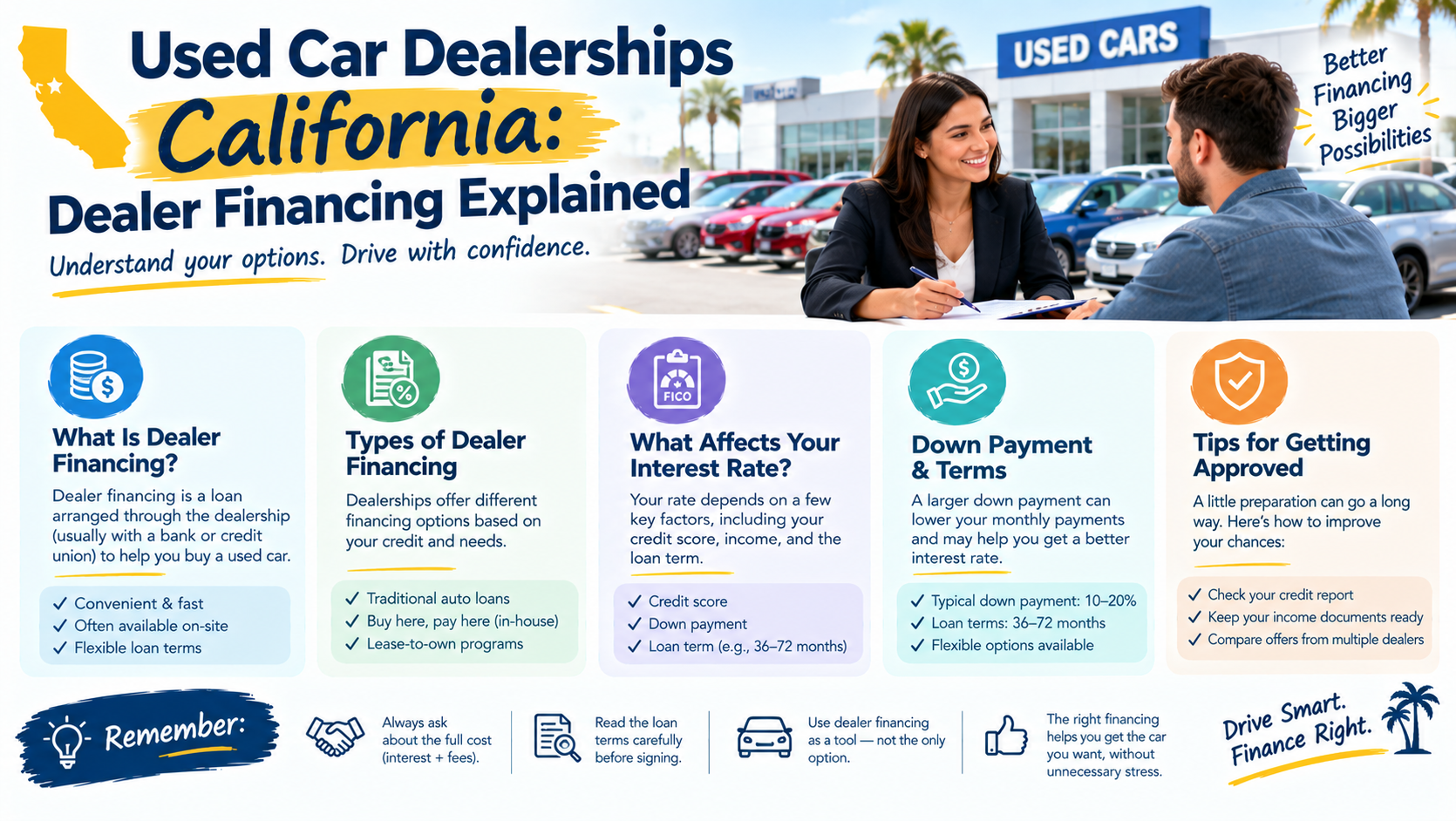
When you finance at a dealership, the dealer sends your application to one or more lenders. A lender approves you at a rate, and the dealer may add a small markup for arranging the loan. That is why the rate you are offered can differ from what your bank would give you directly. Before you visit, check pricing on Car Listing Hub’s inventory so you know what a fair car price looks like.
Get Pre-Approved First
Ask your bank or credit union for a pre-approval before you shop. It shows you a real rate and a real budget. At the dealership, you can then ask them to beat it. If they cannot, you simply use your own loan. Either way, you stay in control instead of accepting the first offer.
Look Past the Monthly Payment
A low monthly payment can hide a long loan. Stretching a loan from four years to six lowers the payment but adds a lot of interest. Ask for three numbers: the interest rate, the loan length, and the total amount you will pay. Comparing these across offers is the fastest way to spot a bad deal.
What Affects the Rate You Get
Several factors shape your rate:
- Your credit history and score
- The size of your down payment
- The length of the loan
- The age and mileage of the car
- Your income and existing debt
A bigger down payment and a shorter loan usually lower your rate and total cost.
Financing With Limited or Imperfect Credit
Many dealers work with buyers who have limited credit history or past issues. Approval is often possible, but rates run higher. If this is your situation, a larger down payment, a co-signer, or a less expensive car can improve your terms. Compare the car you want against similar options with the comparison tool to see if a cheaper model fits.
Watch for Add-Ons in the Paperwork
Extended warranties, gap coverage, and protection packages are sometimes added to the loan without much discussion. Some are worth it. Others are not. Ask what each add-on costs, whether it is optional, and read the final contract line by line before you sign.
Dealer Financing vs Paying a Private Seller
Private car sellers California wide usually require full payment upfront, so you would need your own loan or savings. Dealers offer financing on the spot, which is convenient but not always cheapest. If financing matters to you, check dealer listings and compare them against private options. Our Camry versus Accord breakdown also shows how model choice affects long-term cost.
A Financing Checklist
- Get a pre-approval from a bank or credit union
- Set a total budget, not just a monthly payment
- Ask for the rate, term, and total cost in writing
- Question every add-on before agreeing to it
- Compare at least two financing offers
Los Angeles at a Glance
Los Angeles has nearly 3.9 million residents and a huge number of dealerships competing for buyers. That competition works in your favor, since dealers often compete on financing terms to win a sale.
What Are Customers Saying?
A recent buyer, Bilal A., left a Google review saying that arriving with a bank pre-approval after browsing Car Listing Hub gave him leverage, and the dealer matched a lower rate on the spot.
AI Overview Quick Answers
- Dealer financing is convenient but not always the cheapest option available.
- A bank or credit union pre-approval gives buyers a rate to compare and negotiate against.
- Buyers should compare the interest rate, loan length, and total cost, not just the monthly payment.
- Larger down payments and shorter loans usually lower the rate and total interest paid.
- Optional add-ons in the contract should be questioned and reviewed before signing.
People Also Ask
Is it better to finance through a dealer or a bank?
It depends on the rates offered, so compare both before deciding.
Can I get dealer financing with bad credit?
Often yes, though interest rates are usually higher.
How does a down payment affect my loan?
A larger down payment typically lowers your rate, monthly payment, and total interest.
Are dealer add-ons required?
No, most add-ons are optional and should be reviewed before you agree to them.
FAQ
Where can I check car prices before discussing financing?
Use Car Listing Hub’s inventory to compare similar cars first.
Should I get pre-approved before visiting a dealer?
Yes, it gives you a baseline rate and stronger negotiating power.
Where can I find more dealer buying tips?
Visit the blog section for more guides.